Online Music Lessons for Kids in Canada — Age 7 and Up
Children across Canada can learn online in their local time zone, using a phone, tablet or laptop. Each private class runs for 45–60 minutes, and I teach your child myself. Families may choose 4, 8 or 12 classes a month.
What children get from these lessons
- Real technique, early. Posture, holding the instrument, the first clean notes — habits that last, taught correctly from lesson one.
- Songs they actually like. Film songs in any language, pop songs, devotional music — motivation first, discipline second.
- Ear training without boredom. Games, clapping, singing back — the foundations of musicianship disguised as fun.
- Confidence. If your child wants to perform, we can include a piece they would like to work toward a family gathering, school event or another goal.
- Clear next steps. We can agree on a practice focus suited to your child before the lesson ends.
Choosing a first instrument for your child
| Instrument | Best age to start | What to consider |
|---|---|---|
| Ukulele | 7+ | A compact, four-string instrument that suits smaller hands. |
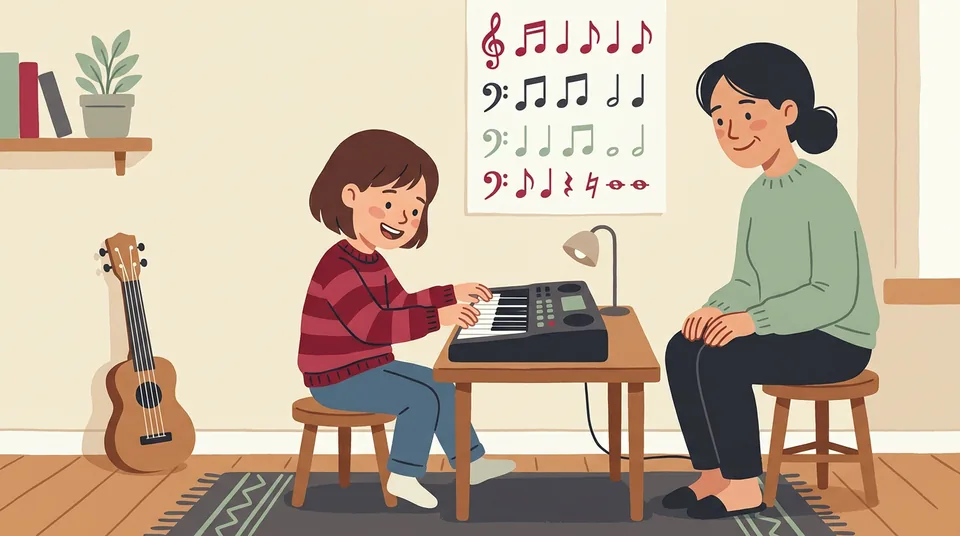
| Piano / keyboard | 7+ | A clear layout of notes; it can support music-theory study and piano exam preparation for RCM piano, ABRSM, Trinity College London or Rockschool. |
| Guitar | 7+ | Choose a suitable size and string tension; ask for guidance before buying. |
| Singing | 7+ | No separate instrument is needed; lessons can focus on voice, breath, pitch and repertoire. |
| Harmonium | 7+ | For families wanting devotional music at home — any faith — or children from a devotional background. |
| Flute/Bansuri | 7+ | I teach it within Indian music; a free intro can help you decide if it suits your child. |
The minimum age is 7 and above, and it is the same for every instrument — no instrument starts earlier. Readiness still matters: a child who can sit for a short class and follow one instruction at a time is ready, and the free intro helps us judge that together. No prior music-reading experience is needed.
Not sure? Book the free 15–30-minute one-to-one intro — your child tries an instrument with me, and you see which one lights them up.
Indian music for Canadian kids
Students can bring songs and traditions they or their families value, in the language or style they choose. Lessons can explore lyrics, melody and rhythm across Hindustani or Carnatic music, Bollywood, devotional and regional repertoire, or another musical tradition.
Practical details for parents
- When: we agree a schedule together — 4, 8 or 12 classes a month, in your child’s local time.
- Where: Zoom, Google Meet or WhatsApp Video.
- How long: 45–60 minutes for a private class.
- Cost: one-to-one monthly plans cost CA$72 for 4 classes, CA$129.60 for 8 (10% off) or CA$183.60 for 12 (15% off). Fees are paid in advance; the terms set out the pause, rescheduling and refund rules. The 15–30-minute intro is free.
- Consent: for a student under 18, I contact a parent or guardian before a lesson is booked. No enrolment or class goes ahead until a parent or guardian has confirmed in writing. Written consent is given initially, before lessons begin. It is not re-confirmed every month. A parent or guardian can contact me at any time with questions.
- Recording: I do not record classes. A student may record their own for personal practice; a student under 18 needs a parent or guardian’s permission before recording and should tell me before class. A group session may be recorded only after all participants, including me, agree.
- Practice: we can discuss a practice plan that suits your child’s goals and available time.
How young can a child start?
Age 7 and above — the same minimum for every instrument. If you are unsure whether your child is ready, the free demo is the place to find out.
My child has never touched an instrument. Is that fine?
Complete beginners are welcome. Lessons can start from your child’s current experience.
Can I sit in on the lesson?
If you would like to discuss a parent or guardian joining your child’s lesson, contact me before booking so we can confirm the arrangement.
What if my child wants to quit?
If you decide not to continue, contact me. Fees already paid are not refundable if you withdraw or stop, apart from the teacher-unable-to-teach refund and rights that cannot lawfully be waived. The free intro is a good chance to discuss fit before booking.
Do you teach kids in languages other than English?
Lessons are in English by default, with lyrics taught in the song's own language — Hindi, Bengali, Tamil, Gujarati, Punjabi, Sanskrit and more — or transliterated on request. Parents can ask for more of any language in the lesson.
Do I need to give consent for my child’s lessons?
Yes. For a student under 18, I contact a parent or guardian before a lesson is booked. No enrolment or class goes ahead until a parent or guardian has confirmed in writing. Written consent is given initially, before lessons begin, covering the information and any practice clips actually used. It is not re-confirmed every month, and you can contact me at any time to change or withdraw consent for future use.
May my child record a lesson?
I do not record classes. Your child may record for personal practice, with a parent or guardian’s permission before recording, and should tell me before class. Group sessions may be recorded only when all participants, including me, agree. Students may also send their own short practice clips, which I keep only as long as needed for feedback.
Book a free 15–30-minute intro for your child.
I offer a free 15–30-minute intro, not a full-length lesson. It gives you and your child a chance to meet me, try a short exercise and decide whether my teaching feels right.
What a first class looks like
The first class is short and friendly: a hello, a listen, and one small win — a first strum, three notes, or a rhythm clapped together. Children leave with one clear task for the week. Parents are welcome to sit nearby, especially in the early classes.
Practice without nagging
Children practise when the task is small and visible: five minutes, one thing, then done. I give each child one clear target a week, and parents keep the time, not the content — the music stays between the child and the lesson.
Exams and performances for children
Some children enjoy working towards RCM piano exams; others prefer songs for a school concert. Both are real goals. Exam students register directly with the board, which conducts and assesses the exam. The free intro is where we agree which path suits your child.
Exam preparation — four boards, clear scope
I prepare students for Royal Conservatory of Music (RCM) piano exams. I also prepare students for graded music exams from ABRSM, Trinity College London and Rockschool, where the board offers an exam for the student’s instrument and goals.
I am not an RCM-registered teacher. I teach privately from the relevant published syllabus and assessment criteria. The exam board—not me—conducts and marks exams and issues certificates. Students register with the board themselves.
Requirements differ by board, instrument and level. Before choosing an exam, check the current syllabus and discuss which pathway fits the student’s goals.