
How Much Do Music Lessons Cost in Canada? An Honest 2026 Breakdown
Music lesson costs in Canada can be hard to compare at a glance. If you are a parent in Toronto, Calgary, Ottawa or Surrey, marketplaces may quote US dollars while local teachers say “it depends”. This guide sets out my current prices alongside online and in-person options; my fees page has the latest details.
The honest numbers
Fee structures checked October 10, 2026. Several Canadian school pages show “$” without naming a currency; where an amount appears below, I label it CA$ based on the provider’s Canadian location. Confirm currency, taxes, registration, travel costs and current availability with the school before booking.
Canadian music-school prices
| School and location | What the published fee page says |
|---|---|
| Manitoba Conservatory of Music & Arts — Winnipeg | Weekly individual lessons in 30-, 45- and 60-minute formats; the rate depends on instructor credentials and experience. A non-refundable annual registration fee of CA$50 per student or CA$100 per family also applies. |
| Academy of Music — Winnipeg | Four lessons are billed monthly at CA$120, CA$180 or CA$240 depending on whether the lesson runs 30, 45 or 60 minutes. In-home travel fee is extra. |
| Toronto School for Strings and Piano — Toronto | The fee depends on the Associate, Artist or Maestro teacher tier and on whether the lesson runs 30, 45 or 60 minutes. The fee page lists a 20% introductory discount for the first four lessons and an annual registration fee. |
| Vancouver Academy of Music — Vancouver | Private lesson packages include single, half-semester and semester options, with fees set by department and teacher seniority. Online lessons are available by contacting the academy. |
Publicly listed private tutors in Canada
These individual tutor profiles are specific teachers and subjects—not a market average. Their listings show different lesson lengths and formats, so confirm the exact quote and availability with the tutor.
| Public profile and location | Lesson options shown |
|---|---|
| Accordion teacher — Toronto area | 30, 45 or 60 minutes; around Toronto and online from Canada. |
| Composition and production tutor — Montréal | 30–120-minute options; at the tutor’s location or online from Canada. |
| Singing and piano tutor — Ormstown listing, Salaberry-de-Valleyfield area | 30, 45 or 60 minutes; local lesson options and exact service radius should be confirmed with the tutor. |
Online platforms and my current rates
| Option | Published example or current rate | What to compare |
|---|---|---|
| Online Indian-music lessons: Spardha | Level-specific course fees for 60-minute sessions, set by course level | Spardha’s current Indian-vocals courses list level-specific rates; confirm the course you need. |
| Online music lessons: Artium | Course-specific fees | Artium’s official FAQ directs families to each course page for current fees. |
| Lessonface platform average | Teacher-set rates; no single platform rate | Lessonface’s teacher-set rates vary by instructor; its displayed average is not a Canadian market average. |
| My private lessons — live online | One-to-one monthly plans: 4 classes for CA$72, 8 for CA$129.60 or 12 for CA$183.60, each 45–60 minutes. | Taught personally by Dr Banerjee: PhD (Oxford, 2008), teaching since 1992, 61 releases, 11 books |
| My small-group classes — live online | CA$96 per student for a fixed 8 classes a month; each class runs 60–90 minutes, and a batch can be formed with 5 to 8 students, depending on the batch | Instruments I teach, singing or music theory; a batch can be formed with 5 to 8 students, depending on the batch |
These are provider-specific snapshots, not national averages or like-for-like offers. Teacher experience, subject, tier, package, lesson length, registration and travel charges differ. Platform prices can be in another currency and depend on the course or teacher; check the linked pages before comparing.
How does a direct lesson differ from a marketplace course?
Online academies may include a curriculum, course materials, scheduling tools or other platform features, while a direct private lesson is a different package. I set my own rate and teach each one-to-one class myself. Compare the lesson length, teacher continuity, subject, and what is included—not only the headline price.
My current rates are CA$72 a month for 4 one-to-one classes and CA$96 per student for the month for each group class, with 8 classes a month. See the fees page for current details; group size and exact class length vary by batch.
What about “cheap” options?
- YouTube tutorials are free and genuinely useful for practice — but they cannot hear you, correct your pitch, or notice that your child is holding the guitar wrong. They complement lessons; they do not replace a teacher.
- Group classes can cost less per student than one-to-one lessons, but compare batch size, class length and how feedback is shared. My small-group classes cost CA$96 per student for a fixed 8 classes a month; each class runs 60–90 minutes, and a batch can be formed with 5 to 8 students, depending on the batch.
- Apps with sheet music teach reading, not playing. The ear — the thing that makes music — is only trained by a human listening back.
The costs nobody mentions
- The wrong instrument. A guitar bought on impulse and abandoned in January. A keyboard with unweighted keys that teaches bad touch. I offer buying advice in the free intro — before you spend anything.
- A poor fit. A long commute, a schedule that is hard to keep, or a teaching style that does not suit the student can interrupt progress. Think about logistics and fit as well as the fee.
- Extra costs after a change. Replacing an unsuitable instrument or changing lesson format can add time and expense. The free 15–30-minute intro is a chance to discuss the student’s goals, setup and schedule before deciding.
A simple way to think about it
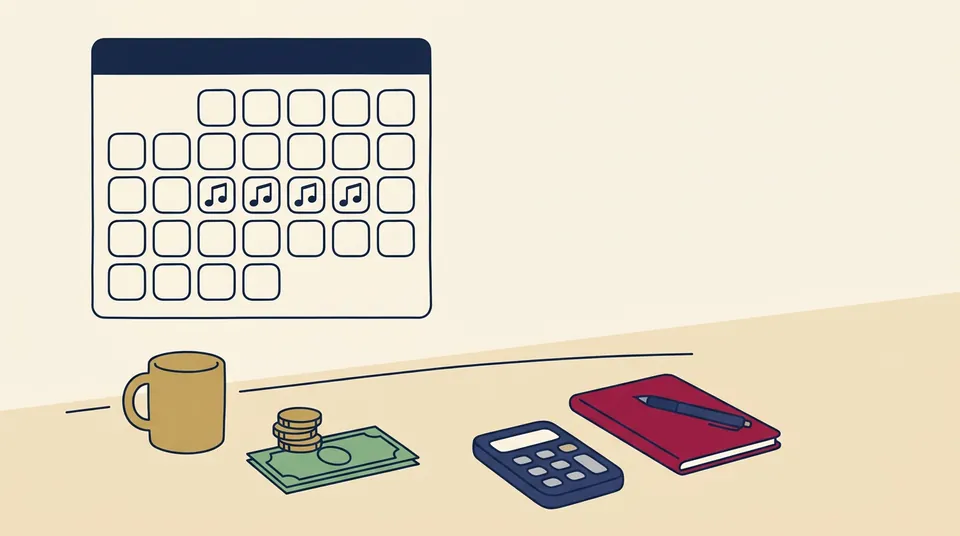
At my current rate, twelve months of the 4-class plan would cost CA$864 (12 × CA$72), before instrument or material costs. This is a calculation using my fee, not a Canadian market average. This is an illustration of twelve monthly 4-class plans — 48 classes in all — not a recommended schedule; students may choose 4, 8 or 12 classes a month.
If the rate and format fit your budget, start with a free intro and see whether the teaching suits the student before booking ongoing classes.
What changes the price of lessons in Canada
Quotes vary by format and length: one-to-one versus group, class length, and how the plan is booked. Travel-based home lessons carry travel time; platform marketplaces add their own margin; fixed monthly plans keep the number steady. What matters for comparison is the same ruler: total per month, classes per month, class length.
Ek aur cheez dekhna: what happens to paid classes you do not use. Pause rules and the refund policy if a teacher cannot teach are part of the real price.
Budget worksheet: ek month ka example
- Pick the format first: one-to-one or group.
- Write the monthly total: 4 classes at CA$72, 8 at CA$129.60, 12 at CA$183.60, or group 8 for CA$96 per student.
- Divide the monthly total by the classes in it for your own comparison sheet (this is arithmetic, not the way plans are sold).
- Check the policy page for pauses, rescheduling notice and the 14-working-day refund if the teacher cannot teach.
Sample budgets: three families, three shapes
Three real-shaped examples show how the same price list fits different lives. A child trying piano for the first term: 4 classes a month at CA$72, paused after the term if needed, with unused classes kept for two months. A teen working toward RCM Level 5: 8 classes a month at CA$129.60, steady through the year. An adult returning to guitar with a burst of free time: 12 classes at CA$183.60 for two months, then down to 8.
Same list, three shapes. The plan serves the season of life, not the other way round.
Questions to ask before you compare any price
- Is the quote a monthly total or a rate that multiplies at checkout?
- How many classes does a month actually include, and how long is each?
- What happens to paid classes when you travel or fall ill?
- Is there a registration or annual fee that appears later?
Ask once, in writing. A teacher who answers these four clearly is usually easy to deal with on everything else.
Is the free one-to-one intro really free?
Yes — 15 to 30 minutes with me, no card, no commitment. See the demo class page.
Do you charge in US dollars?
No. Canadian students pay in Canadian dollars — one-to-one monthly plans of 4 classes for CA$72, 8 classes for CA$129.60 (10% off) or 12 classes for CA$183.60 (15% off) — by PayPal, Remitly or Western Union.
What does a small-group class cost?
Group classes are a fixed 8 classes a month for CA$96 per student; each class runs 60–90 minutes, and a batch can be formed with 5 to 8 students, depending on the batch. They cover instruments I teach, singing and music theory.
What are your private and group lesson rates?
My one-to-one monthly plans are CA$72, CA$129.60 or CA$183.60 for 4, 8 or 12 classes of 45–60 minutes. Group classes cost CA$96 per student for a fixed 8 classes a month; each class runs 60–90 minutes, and a batch can be formed with 5 to 8 students, depending on the batch. Rates differ, so compare currency, class length, group size and what is included.
Exam preparation — four boards, clear scope
I prepare students for Royal Conservatory of Music (RCM) piano exams. I also prepare students for graded music exams from ABRSM, Trinity College London and Rockschool, where the board offers an exam for the student’s instrument and goals.
I am not an RCM-registered teacher. I teach privately from the relevant published syllabus and assessment criteria. The exam board—not me—conducts and marks exams and issues certificates. Students register with the board themselves.
Requirements differ by board, instrument and level. Before choosing an exam, check the current syllabus and discuss which pathway fits the student’s goals.