
Online vs In-Person Music Lessons in Canada: An Honest Comparison
Choosing online vs in-person music lessons in Canada starts with one practical question: which format suits your family? Both can work. The deciding factors are narrower than the marketing suggests, and one of them matters more than all the rest.
What the published fees actually tell you
Published fee structures can help with budgeting, but they are not a Canadian market average. The structures below were checked October 10, 2026. Some school pages show “$” without spelling out currency, so confirm currency, lesson length and any extra fees before booking.
| Format | Published example or current rate | What to check |
|---|---|---|
| Canadian music academies and schools | Manitoba Conservatory (Winnipeg): individual lessons in 30-, 45- and 60-minute formats, with rates set by teacher credentials; Academy of Music (Winnipeg): four-lesson monthly billing; Toronto School for Strings and Piano: rate by Associate, Artist or Maestro teacher tier; Vancouver Academy of Music: lesson packages by department and teacher seniority. | Rates use different teacher tiers and packages; registration or travel charges may apply. See the full Canadian cost comparison for more details. |
| Public Canadian private-tutor listings | Toronto accordion; Montréal composition/production; Ormstown-area singing/piano: individual listings with 30–120-minute options. | Individual listings, not an average. Profiles show different lesson lengths and local or online formats; confirm the exact lesson length and quote. |
| Online Indian-music classes: Spardha | Level-specific course fees for 60-minute sessions | Current Indian-vocals course prices vary by level. |
| Online music classes: Artium | Course-specific fees | Artium’s FAQ directs families to each course page for current fees. |
| Lessonface platform average | Teacher-set rates; no single platform rate | Teachers set their own rates; there is no single Canadian rate to compare. |
| My private online class | 4 classes for CA$72, 8 for CA$129.60 or 12 for CA$183.60 a month | Taught personally by Dr Banerjee; see my fees page for current details. |
| My small-group online class | CA$96 per student for a fixed 8 classes a month; each class runs 60–90 minutes, and a batch can be formed with 5 to 8 students, depending on the batch | Instruments I teach, singing or music theory; a batch can be formed with 5 to 8 students, depending on the batch. |
These are selected examples, not directly comparable offers or a Canadian market average. Teacher tier, subject, duration, currency, class format, registration and travel fees differ. Check the linked sources and compare the actual lesson details before choosing a format.
The variable that actually matters: the teacher
Format does not teach anyone; the teacher, practice and student’s goals matter in either setting. Local options may be limited in some towns or for a particular instrument or tradition. Online lessons can widen the pool beyond the local area, while in-person lessons make hands-on setup easier. A short intro can help you decide whether a teacher’s approach fits.
Online lessons do not guarantee a good fit, and an in-person location does not guarantee one either. Ask who will teach each week, how feedback is shared, and whether you can try a short intro session before committing.
What online can make easier
- Less commuting. The student can join from home, which may save travel time; a reliable internet connection and a quiet place are still important.
- Scheduling across distance. You can consider teachers outside your neighborhood, then confirm that lesson times suit your local schedule.
- Practice follow-up. Ask whether the teacher shares notes, recordings or materials between classes. I share practice guidance with my students.
- A familiar space. Some students prefer to sing or play from home; others do better with an in-person routine. A trial can help reveal the difference.
- Family logistics. Back-to-back online lessons may reduce trips for siblings, and parents can discuss how they can support the lesson.
What in-person can make easier
- Hands-on setup. A teacher beside the student can adjust instrument position directly, which may help some beginners get comfortable.
- Playing with others. Ensembles, bands and group workshops create a shared playing experience that one-to-one lessons do not replace.
- Instrument questions. Demonstrating a physical adjustment or setup issue can be simpler when the teacher is in the room.
- Accompaniment. Voice students may find it convenient to arrange in-person work with a pianist; requirements depend on the repertoire and exam syllabus.
Exams, auditions and the hybrid answer
Exam preparation can be taught online or in person. Boards set their own options and requirements, so check the current guidance for the chosen instrument and exam session. I prepare students for RCM piano exams, and for ABRSM, Trinity College London and Rockschool exams where relevant; students register directly with the exam board. Some families combine online lessons with in-person ensembles or workshops so students can also play with others.
So which should you choose?
- Younger beginner: consider which setting helps the student focus and feel comfortable; parent support or a short trial may help you decide.
- Child or teenager: compare teacher experience, lesson structure, screen comfort and family schedule rather than relying on age alone.
- Small town or rural area: online lessons can widen the choice of teachers beyond the local area.
- Adult returning to music: compare travel time, work commitments and the time of day each teacher can offer.
- Exam student: either format can support preparation; check the teacher’s experience with the selected board and instrument. RCM preparation here is for piano.
- Budget-conscious family: compare private and group rates, session length, batch size and currency. My private classes are one-to-one monthly plans of 4 classes for CA$72, 8 for CA$129.60 or 12 for CA$183.60, each class lasting 45–60 minutes; my small-group class is CA$96 per student for a fixed 8 classes a month; each class runs 60–90 minutes, and a batch can be formed with 5 to 8 students, depending on the batch.
Hybrid option: online lessons with live performances
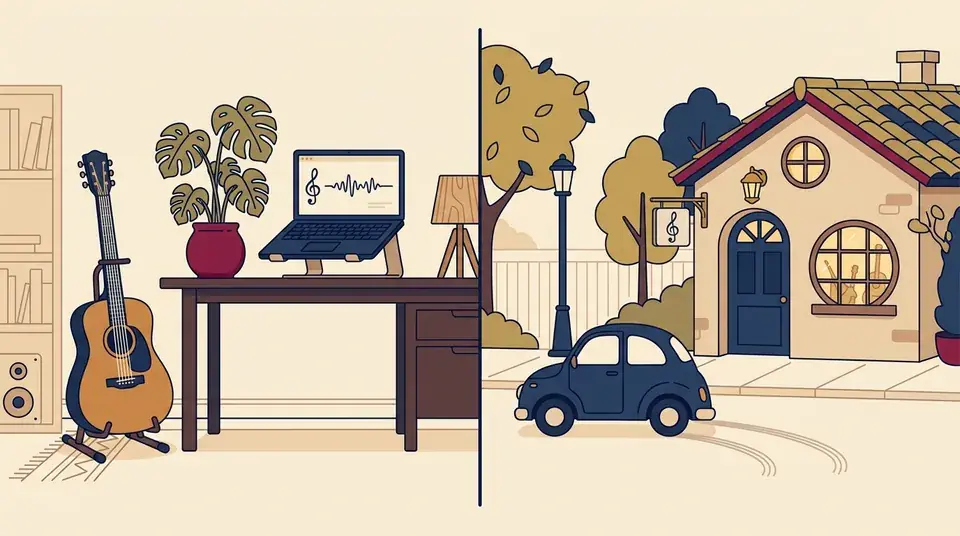
Online does not mean isolated. Many students pair weekly online classes with occasional live moments — a family mehfil at home, a school concert, an open mic — so the performance skill grows too. The lesson handles the building; the living room or school stage handles the sharing.
Canada ke schools aur community centres mein open mics common hain — ek saal mein ek performance, practice ko naya context de deta hai.
What in-person does better (and when it matters)
Honesty helps decisions. In-person wins on a few margins: very young children who focus better with a teacher physically present, advanced collaborative work like duo or accompaniment rehearsals, and students without a quiet home corner. Where those margins matter, a blended plan — mostly online with the occasional in-person workshop — is a fair answer.
For everyone else, the commute saved is practice gained.
Do online lessons work for children?
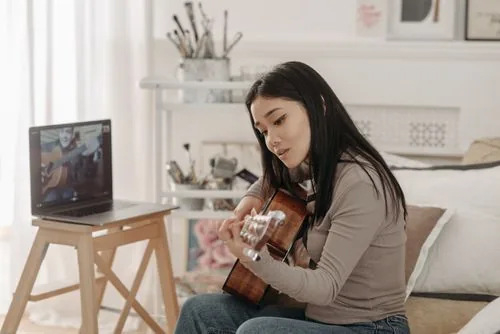
They can work well when the child is comfortable with the screen, the camera shows the instrument clearly, and the lesson is paced for the student. A parent can help younger learners get set up; a short intro is a practical way to test the fit.
What equipment do we need?
A phone, tablet or laptop with a camera and an internet connection — plus the instrument, or just a voice for singing. A holder or stand for the device helps; nothing else is required.
Are online lessons always cheaper?
Not always; prices depend on the teacher, course, currency and lesson length. My one-to-one monthly plans are CA$72 for 4 classes, CA$129.60 for 8 or CA$183.60 for 12, and my group class is a fixed 8 classes a month for CA$96 per student; each class runs 60–90 minutes, and a batch can be formed with 5 to 8 students, depending on the batch. See my cost comparison and compare like-for-like rates.
Can my child prepare for a graded music exam online?
Yes. Lessons can support syllabus-based preparation online. Check the chosen board’s current exam guidance and registration steps; RCM preparation here is for piano.
What if we try it and it is not right?
The free 15–30-minute one-to-one intro carries no commitment. If the format does not suit your child, you will know in that intro, and nothing is owed.
Exam preparation — four boards, clear scope
I prepare students for Royal Conservatory of Music (RCM) piano exams. I also prepare students for graded music exams from ABRSM, Trinity College London and Rockschool, where the board offers an exam for the student’s instrument and goals.
I am not an RCM-registered teacher. I teach privately from the relevant published syllabus and assessment criteria. The exam board—not me—conducts and marks exams and issues certificates. Students register with the board themselves.
Requirements differ by board, instrument and level. Before choosing an exam, check the current syllabus and discuss which pathway fits the student’s goals.