Can You Really Learn Hindustani Music Online? Yes — Here Is How
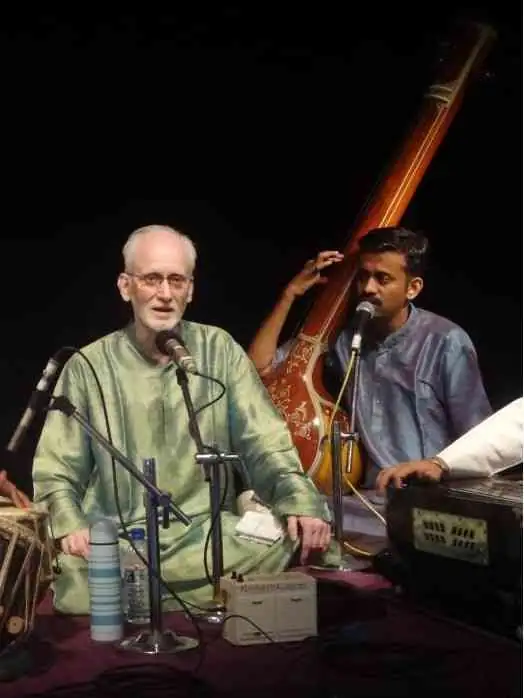
Hindustani music lessons online can work well because the tradition is taught through listening and response: I sing a phrase, the student repeats it, and I correct one thing at a time. In-person learning has its own value, but a live video call can carry much of that exchange while removing the distance.
What makes it work online
For a cultural overview of Indian classical music and the use of raga and taal, see the Sangeet Natak Akademi’s music section.
- Listening is central. The student repeats a phrase and I give one focused correction. A camera and microphone can support that call-and-response, although they do not replace every part of learning in person.
- Tanpura and rhythm. A tanpura drone and a theka (rhythm cycle) can support pitch and rhythm practice during lessons.
- Notation alongside listening. Sargam and bandish notation can be introduced alongside listening and repertoire, depending on the learner’s goals.
- Practice materials. We can discuss which lyric or notation materials may support practice. If a recording is proposed, discuss its purpose and any planned sharing before the lesson.
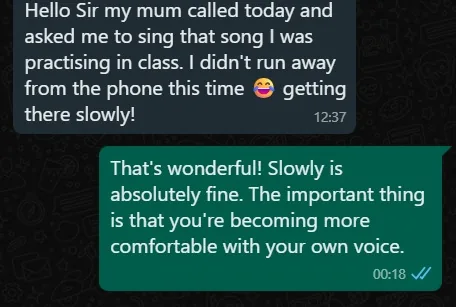
What a typical online lesson looks like
Two minutes of review — what held, what slipped.
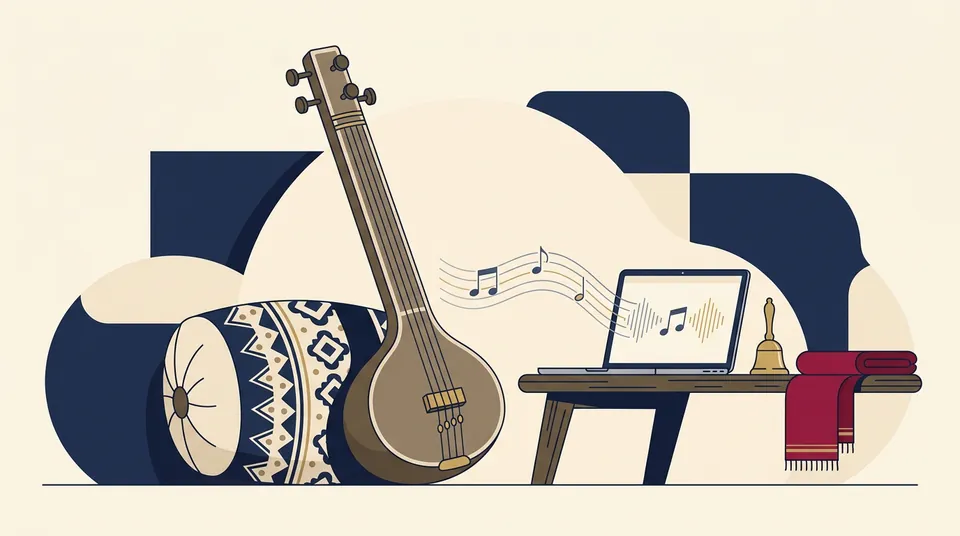
The teacher sings it twice — once slowly, once at tempo. The student repeats it until it sits.
A breath placed wrong, a swara bent, a tala rushed. One correction, practiced immediately.
A short, specific list: one phrase, one rhythm, one song — with the drone track to practice against.
The honest limitations
Two things are genuinely harder online. The first is the very first month — posture, holding the instrument, the physical feel of the tanpura — which is why the free intro matters, and why the teacher watches the hands on camera. The second is group energy — the sangat, the collective singing of a bhajan evening, cannot be recreated on a screen. Everything else — sargam, raga, tala, repertoire, exam preparation — translates completely.
Repertoire and lesson schedule
Lessons can begin with sargam, raga, bandish, devotional repertoire or a film song shaped by Hindustani music. Classes are scheduled together in local time, and students may choose 4, 8 or 12 classes a month. I teach each class personally.
Raga pehchanna: listener ka pehla kadam
Online learning sharpens a listening habit that Hindustani music has always asked for: raga pehchanna. Start with two ragas only — hear one recording of each, every day, for two weeks. The ear begins to hold a scale's mood, then its signature phrases, then its movement. A student who can hear the difference brings that same attention to their own practice.
Class sun-na practice ka hissa hai, practice se alag cheez nahi.
Online tanpura and lehra apps: setup
- Pick one tanpura app and stay with it — the drone should feel like home, not a new sound each week.
- Set the shruti to your comfortable pitch once; write it down.
- For instrumental learners, a lehra (looped accompaniment) app adds rhythm practice for slow and medium tempi.
Technology here plays the old role of the family tanpura: steady, patient, always in tune.
Online vs in-person for Hindustani: ek honest comparison
Hindustani training once demanded the teacher's physical presence — sitting beside the tanpura, hand signals for tala. Online classes replace much of that: the drone comes through your own shruti box, the camera shows the hand and the breath, and recordings let you revisit a phrase exactly as sung. What online still cannot do is fix your posture with a light touch from across the room, so the teacher describes, and you adjust, more verbally.
For motivated students the trade is small; for very young children, a parent sitting nearby for the first weeks closes most of the gap.
A first-month plan for the online student
- Week 1: settle the shruti, learn to sit, sing the sa steadily for a minute.
- Week 2: first four sarali-style patterns, slow, with the drone on.
- Week 3: add one simple alankar and a two-line bhajan or bandish fragment.
- Week 4: record one take, listen together in class, fix one thing.
One month, one habit, one honest recording — that is the whole foundation.
Do I need a tanpura app?
Not necessarily. We can discuss using a tanpura app or another drone source during a lesson; whether you want one for practice depends on your goals.
Can a child learn classical singing online?
Yes. The starting point depends on the child’s age, experience and goals. A film song, basic sargam or another suitable piece can be discussed at the free intro.
How is it different from a YouTube tutorial?
A tutorial cannot hear you. It cannot notice that your “ma” is flat, or that your theka rushed, or that you are holding your breath. The correction loop — sing, hear, fix — is the entire tradition, and it needs a listener.
Is there a free intro session?
The free 15–30-minute one-to-one intro is live, with no commitment. Book it on the demo class page.